
Inject 200 ms latency and verify recovery
Use an isolated local Proxy to compare normal, delayed, and recovered MQTT behavior without touching existing Proxies.
- Author:
- Mqttable
- Updated:
On this page4 sections
Loading...
Use an isolated local Proxy to compare normal, delayed, and recovered MQTT behavior without touching existing Proxies.
Loading...
You will create an isolated loopback Proxy from 127.0.0.1:28883 to 127.0.0.1:1883, run scheduled messages through one test Connection, establish a baseline, and keep about 200 ms downstream latency active for review. Cleanup removes the fault and confirms recovery.
Both ports must belong to your disposable local environment. Stop if either endpoint is not loopback or is already used by another task.
Send this single paragraph to the Agent connected to Mqttable:
Main prompt
Use the connected Mqttable MCP tools to create an isolated Proxy from 127.0.0.1:28883 to 127.0.0.1:1883 and one test Connection through it. Schedule messages, establish a baseline, then add 200 ms downstream delay and leave traffic running for review. Preserve existing objects and return the exact cleanup list.
The Agent chooses temporary names, creates only isolated test objects, leaves existing configuration unchanged, and returns the exact object list in its completed report for cleanup.
After a successful run, confirm these signals in Mqttable:
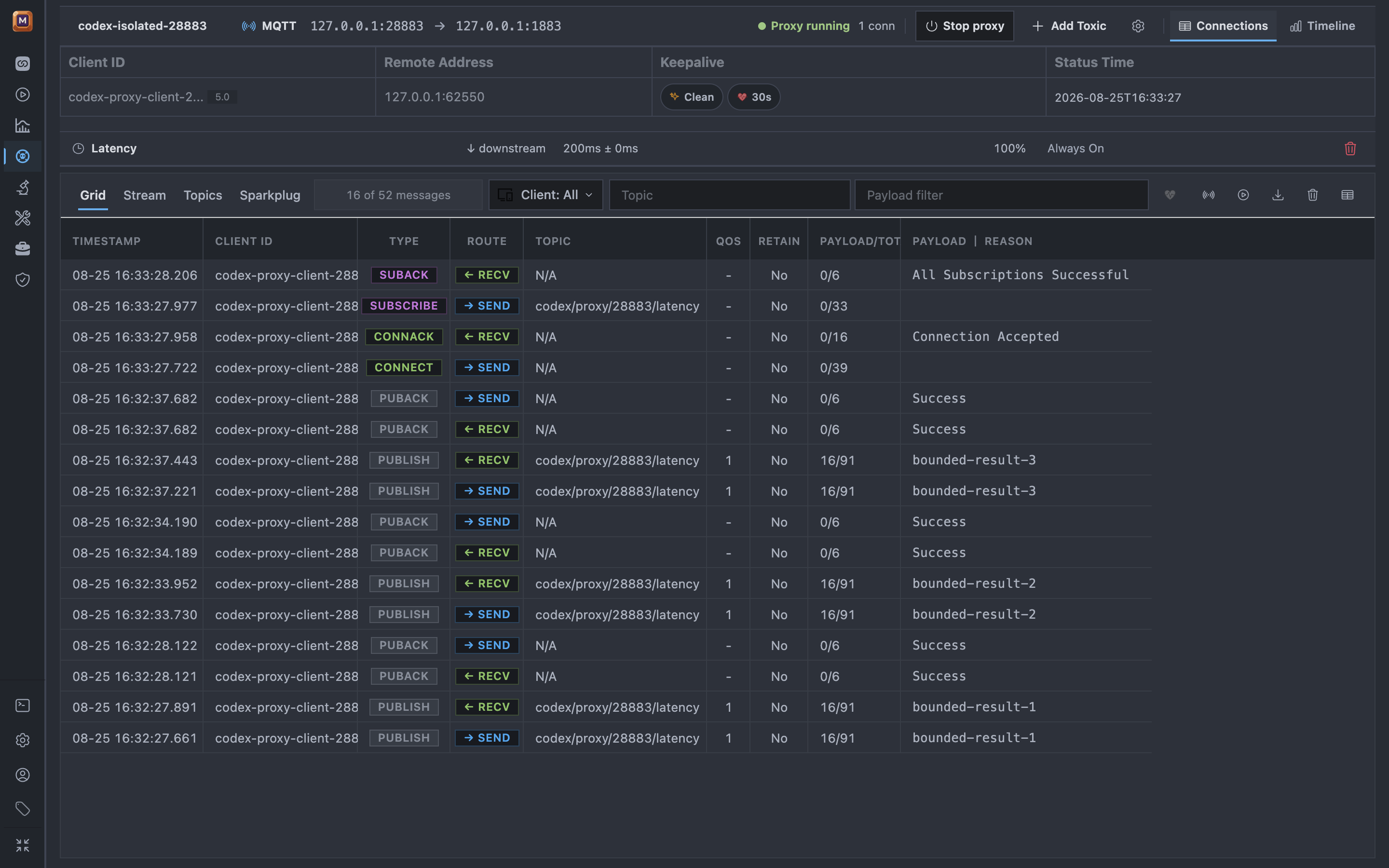
The isolated Connection keeps the Proxy route active while the 200 ms downstream toxic and bounded QoS 1 traffic remain visible for review.
If any success signal is missing, stop without expanding the scope and use Troubleshooting.
In the same Agent conversation, send:
Cleanup prompt
Stop only the reported schedule, then remove this Broker, Connection, delay Toxic, and Proxy. Preserve everything else and confirm recovery.
Continue with PCAP Analysis to diagnose an existing capture analysis.